Friday, July 5, 2024

Reflections on My New Car: A Journey of Anticipation and Unease

Reflections on My New Car

I recently decided to fetch my new car, but I find myself regretting the purchase even before taking delivery and becoming its owner. Perhaps it’s the weight of anticipation or the fear of the unknown.

Last night, I had a vivid dream that seemed to revolve around the car.

In my dream, I was driving along a beautiful highway, the only vehicle on the road. The incline grew steeper and steeper until I reached the edge.


There, the highway plunged dramatically into the sea. Strangely, I had shifted the car into second gear, and I noticed other cars submerged in the water, tied to floats resembling the top half of containers but much smaller than a real container - hardly longer than the car. Despite the surreal scene, I felt concern rather than fear.

A woman’s voice echoed over a PA system, like that of a flight attendant, announcing something I couldn’t quite make out. Dreams can be cryptic, and this one left me with a sense of foreboding. Falling or descending often symbolizes negative omens, and I wonder if my subconscious is trying to tell me something about my new, second hand car.

As if to reinforce this unease, rain is imminent as I approached the dealer's place to fetch the car, a 2007 MyVi 1.3 (A), and I lack confidence in driving an unfamiliar car in wet conditions.

Perhaps it’s time to reflect on my decision and address any lingering doubts, but there's no going back.

As it happens, I got home safely; the rain was intermittent and was not heavy.

But wife and son didn't even ask about the car. Anyway. Life's like that.

My Car Adventure

Last night, I had a vivid dream centered around the car. In this dream, I was driving along a beautiful highway—the only vehicle on the road. The incline grew steeper and steeper until I reached the edge, where the highway dramatically plunged into the sea. Strangely, I had shifted the car into second gear and noticed other cars submerged in the water, tied to floats resembling small containers. Despite the surreal scene, I felt concern rather than fear.

Dreamy Car Adventure

Friday, June 28, 2024

Car Matters

I brought along Sam Addams, and Mel tagged along, too. Sam has a knack for cars—he used to sell spare parts and has always opted for secondhand vehicles. So, he’s no stranger to the ins and outs of buying used cars. His take on this particular one? Well, at RM10,500, it’s an absolute steal. We decided to take it for a test drive.

As for my impressions, the handling seemed decent—no sudden jolts and the ride was smooth, albeit a tad sluggish (it’s a 1.3, after all). Plus, no mysterious clunks or rattles from the drive shafts. On the exterior, there weren’t any glaring signs of major collisions—though the seller did confess to a minor right-side fender bender that required a headlight replacement.

Things looked pretty good inside, except for a rust spot on the right rear door near the wheel arch. It outshone the other cars we’d seen, except for that elusive first one (which vanished before I could even blink). Definitely better than the Batu Pahat model. But—and here’s my only gripe—the engine growls like an angry cat. Much louder than the Batu Pahat version Iqi’s father arranged through a dealer. That one was quieter, though admittedly not as spiffy inside and out. Still, this car boasts a fresh coat of paint—original colour, mind you—just a quick spray layer on the outside."


                        Car: Perodua MyVi 1.3A

                        Model Year: 2007

                        Asking Price: 10,500 + Name change

                        Reg: WQB3707

                        Insurance: RM 1200

                        Road Tax: RM 70

                        Total: RM 11,770


“Car Chronicles: The Great RM10,500 Steal!”

So, here’s the scoop: I had a rendezvous with Sam Addams and Mel—the dynamic duo of car enthusiasts. Sam, the seasoned spare parts seller, knows cars like the back of his hand. And guess what? He’s always been a fan of secondhand beauties. So, he practically did a happy dance when we stumbled upon this gem priced at RM10,500. We decided to take it for a spin, just to see if it lived up to the hype.

Now, my turn behind the wheel: The handling? Not bad at all—no sudden jolts, and the ride was smoother than a jazz sax solo (okay, maybe a tad sluggish—it’s a 1.3, after all). And the best part? No mysterious clunks or rattles from the drive shafts. Exterior-wise, no major collision scars—just a minor right-side fender bender that needed a new headlight. Inside? Pretty darn good, except for that sneaky rust patch on the right rear door. But hey, it outshone the other cars we’d seen, except for that elusive first one that vanished quicker than a magician’s rabbit.

But—and here’s the drumroll—the engine growled like a caffeinated tiger. Seriously, louder than a rock concert. Sam, our resident car whisperer, had a theory: engine mounting. Apparently, it’s like a car chiropractic adjustment. Plus, this poor thing hadn’t hit the road in ages. Fingers crossed, right? Because guess what—I already pulled the trigger and now have to bite the bullet (ouch!).

Now, the guilt trip: Iqi’s father and the kind-hearted Iki had their hearts set on that Batu Pahat car. It would’ve set me back RM14,800 on-the-road (yikes!). But hey, I’m saving RM3,030, so maybe I’ll slip Iqi’s dad a little thank-you bonus of RM300. It’s the least I can do for their trouble.

So, here’s to my new ride—a mix of excitement, engine growls, and a dash of guilt. Wish me luck, and may the car gods be on my side! 🚗🤞


🚗 The MyVi Misadventure

So there I was, eyeing that sleek black MyVi 1.3A like a kid in a candy store. The price? A cool RM15,800. Bargaining skills? Zero. Test drive? Zilch. But who needs practical details when you’re daydreaming about cruising down the highway, right? 🤷‍♂️

Fast forward to reality: The MyVi slipped through my fingers like sand at the beach. My family and Iqi (plus his dad, because why not?) would probably chuckle at my missed opportunity. Lesson learned: I’ll be ready to haggle like a pro and take that test drive next time!

🚙 The Altis Conundrum

Ah, the allure of a 2006 Toyota Altis! Priced at RM16,800, it was like a siren calling me from the used car lot. But hold up—buying it would defeat my whole purpose of getting a second car:

  1. Diesel Ringgit Saved: My master plan? Use the Ford Ranger less and save on diesel. Brilliant, right? 🌿
  2. Service Intervals: I pondered: Could I stretch the Ranger’s service schedule from thrice a year to twice? 🤔

Honestly, I’m in uncharted territory here. Have I made the right choice? Who knows! But hey, making questionable decisions is my superpower. 🦸‍♂️ It’s just me embracing the chaos of car shopping.


Monday, May 27, 2024

Malaysia Laughter Championship 2024

 **Ipoh Resident Jayamalar Jeyaratnam Crowned Malaysia Laughing Champion 2024**


Ipoh, Perak - The jovial spirit of Malaysia has a new face: Jayamalar Jeyaratnam, 66, from Ipoh, who has been crowned the Malaysia Laughing Champion 2024. Jayamalar triumphed in a laughter-filled event hosted by the Johor Bahru Happy & Joyous Club, held via Zoom on Sunday, May 26 2024. 

This is the third time since 2021 the championship has taken place, with this year's event attracting a global audience. Jayamalar, along with other Malaysian laughter enthusiasts, showcased their mirth from 2:00 to 3:00 p.m. in a bid to represent Malaysia at the World Laughing Championship on June 1, June 1

Open to Malaysians aged 18 and above, the competition judged participants on Humility, Joyfulness, Sparkle, Contagiousness, and Originality. Eight finalists were selected from laughter video submissions, advancing to the live Laughter Challenges. The contest was a battle of belly laughs, featuring rounds of personal best laughter, animal-themed laughter, shy laughter, and playful playground laughter. After three elimination rounds, it came down to Jayamalar and Catherine Lim, with Jayamalar ultimately taking the title.


Spectators from over 12 countries tuned in to enjoy the laughter, including viewers from Belgium, Austria, India, Germany, USA, Japan, Australia, England, Bahrain, Mauritius, Singapore, and Malaysia.


The 2024 contestants were:


- Tay Chin Hung (Johor)

- Vimala Devi A/P A. Arunasalam (England)

- Catherine Lim Suat Har (Kuala Lumpur)

- Jayamalar A/P Jeyaratnam (Perak)

- Rajaperumal Visvanathan (Kuala Lumpur)

- Subramaniam (Perak)

- Koh Mui Cheng (Johor)

- Vickneswari Maniam (Australia)


Laughter, a universal language, has the power to connect people, boost health, and foster joy and peace worldwide. This championship highlights the importance of laughter in our lives, spreading happiness across borders.

**Jayamalar Jeyaratnam Crowned Malaysia Laughing Champion 2024**

Jayamalar Jeyaratnam, a 66-year-old businesswoman from Ipoh, Perak, has been named the Malaysia Laughing Champion 2024. With her heart full of joy and an aim to spread happiness, Jayamalar entered the contest determined to have fun and share laughter's benefits with her community. Throughout the three rounds of the competition, she relied on her heart energy rather than her head, ultimately securing the top spot and opening new doors for her to explore the world of laughter therapy, especially within Ipoh. Still absorbing the surprise of her win, Jayamalar is living in the moment and relishing the joy that laughter can bring.


Catherine Lim, 60, a Therapeutic Laughter Facilitator from Shah Alam, Selangor, secured second place and will represent Malaysia if Jayamalar is unable to. Catherine joined the contest for the fun and experience it offered. As a certified laughter yoga teacher, she embodies the spirit of laughter, spreading joy and connection wherever she goes—whether in shopping complexes, gatherings, or events. To her, laughter is a gift meant to be shared, and she is passionate about spreading joy to the community and the world.


Koh Mui Cheng, a 66-year-old retiree from Johor Bahru, also participated in the Malaysia Laughing Championship for fun, confidence-building, and the experience. Throughout the contest, she felt excited, enthusiastic, and imaginative. Post-competition, she realized the value of practice and gained significant joy and confidence, overcoming her inhibitions and becoming more open to herself and others.


Vickneswari Maniam, 37, a businesswoman from Melbourne, Australia, entered the contest to test her ability to laugh, as she is typically not very social. Initially nervous, Vickneswari found the contest fun and felt happy about her participation afterward. She plans to carry forward the positivity from the contest, recognizing the importance of laughter therapy for human well-being.


The Malaysia Laughing Championship 2024, hosted by the Johor Bahru Happy & Joyous Club, was held via Zoom on 26th MayMay 26ow in its third year, the event saw contestants judged on Humility, Joyfulness, Sparkle, Contagiousness, and Originality. The competition attracted a global audience from over 12 countries and highlighted the power of laughter to connect people, improve health, and promote joy and peace worldwide.


For more information or to share in the joy, contact Jayamalar Jeyaratnam at 012-5386366 or jayajey636@gmail.com.

The Seletars, Malaysia & Singapore

 Even before the Island State split from Malaysia, the Seletars occupied both banks of the Straits, and Singapore did not recognise the Seletar people. When the split occurred, they could become Malaysians, keep their Asli identity, or take up Singapore citizenship, lose this, and become Malays. (This is what I gather from conversations with my Seletar buddies.)

So it's intriguing that more is written about the Seletars from across the Straits than from our side. It seems to me.


Johor hasn't been a friendly place for the Orang Seletar Orang Asli Seletar, Kg Bakar Batu and Kg Sg Temon Johor, even though they once patrolled and collected taxes for the Sultanate from those who passed through the waterway, so much so that the Brits called them pirates. They've even fought wars up and down the Straits and along Sungai Johor, up to Johor Lama from one Western nation to another, and even battled the Achinese, who wanted to bring the West coast of the peninsular into their domain or chase pretenders and claimants to the throne of Melaka or Johor. (As I read somewhere).

But today, they've been booted out of traditional settlements in Stulang, Sg Segget areas and others. Adding to their woes, the development corridor called Iskandar Malaysia will move one community of close to 400 Seletar people to an area where they will lose their primary source of livelihood - mussel farming. Elsewhere, the Seletar community of Gelang Patah have had their traditional fishing areas taken over by a massive shipping port. It's a tough life. Being Asli is tough all around the peninsular.

Sunday, May 26, 2024

 Balancing political statements with your charity's mission on social media can be tricky. Here are several factors to consider when deciding whether to continue posting political content:


### 1. **Mission Focus**

   - **Clarity and Consistency:** Focusing on your charity’s mission helps maintain a clear and consistent message. It ensures your audience understands your primary goals and isn’t distracted or alienated by unrelated political opinions.


### 2. **Audience Engagement**

   - **Donor Diversity:** Your donors likely have a range of political beliefs. Posting political content could alienate a segment of your supporters, potentially reducing donations and engagement.

   - **Community Trust:** Building trust with your community involves demonstrating reliability and neutrality, primarily if your mission serves diverse groups.


### 3. **Legal and Ethical Considerations**

   - **Nonprofit Regulations:** Many countries regulate political activities by nonprofits. For example, in the U.S., 501(c)(3) organisations are restricted from engaging in political campaigning and can risk their tax-exempt status.


### 4. **Brand Image**

   - **Professionalism:** Maintaining a professional image can be crucial for credibility. Political posts may be viewed as unprofessional or divisive, detracting from the charity’s core activities.

   - **Public Perception:** People may perceive the charity as biased or having a hidden agenda, which could impact overall support and participation.


### 5. **Strategic Communication**

   - **Message Alignment:** Ensure all communication aligns with the charity’s goals and values. If political statements align directly with the mission (e.g., advocating for policy changes that support your cause), they may be appropriate.

   - **Engagement Strategy:** Focus on content that highlights success stories, upcoming events, volunteer opportunities, and the impact of donations. Positive and mission-centric content typically generates more engagement and support.


### 6. **Risk Management**

   - **Crisis Management:** Consider the potential backlash and have a plan to address any adverse reactions. Being prepared can help mitigate damage to your charity’s reputation.

   - **Conflict Avoidance:** Staying away from political discourse can help avoid unnecessary conflicts and maintain a harmonious online community.


### Conclusion

While political statements can sometimes be relevant to a charity's mission, it's often more practical to concentrate on content that directly promotes your cause. Highlighting the positive impact of your work, sharing stories from those you help, and providing transparent updates on how donations are used can build more robust, more inclusive support.


In summary, focusing on your charity’s core activities and mission is usually the best approach to maintaining a supportive and engaged community, maximising donations, and avoiding unnecessary conflict

Registering RoS


Deciding whether to remain self-reliant or join established donation platforms and register with government bodies depends on several factors. Here are some points to consider for both options:


####Staying Self-Reliant


**Pros:**

1. **Autonomy:** You have complete control over the charity's operations, including decision-making processes and how funds are used.

2. **Flexibility:** Being unregistered allows you to adapt quickly without the need to comply with regulatory requirements.

3. **Lower Administrative Burden:** You avoid the paperwork and reporting obligations required by government bodies and formal donation platforms.

4. **Direct Relationship with Donors:** You maintain a personal connection with your donors, which can enhance trust and loyalty.


**Cons:**

1. **Limited Funding:** Without access to more extensive, structured donation platforms, your funding sources might be more limited.

2. **Credibility:** Potential donors might hesitate to contribute to an unregistered organisation, limiting your reach and impact.

3. **Sustainability:** Depending solely on personal funds and informal donations might not be sustainable in the long term.

4. **Legal Risks:** Operating without formal registration can expose you to legal risks, especially if there are specific regulations governing charitable activities in your region.


### Joining Established Platforms and Registering


**Pros:**

1. **Increased Funding Opportunities:** Registration and joining platforms like sokong.org can open access to a broader range of donors, grants, and other funding opportunities.

2. **Credibility and Trust:** Being a registered entity enhances your legitimacy and trustworthiness in the eyes of potential donors and beneficiaries.

3. **Support and Resources:** Established platforms often provide resources, training, and support to help you run your charity more effectively.

4. **Long-term Sustainability:** With increased funding and resources, your charity will likely sustain and expand its operations.


**Cons:**

1. **Administrative Burden:** Registration involves paperwork, adherence to regulations, and ongoing reporting requirements, which can be time-consuming.

2. **Less Flexibility:** Complying with regulatory requirements and platform policies can limit your flexibility in how you run your operations.

3. **Costs:** There may be costs associated with registration and using donation platforms, which can eat into your funds.

4. **Potential Loss of Personal Touch:** As you grow and formalise operations, you might lose some personal connection with donors and beneficiaries.


### Considerations for Decision-Making


- **Scale of Operations:** If your charity is small and manageable with personal funds and local donations, staying self-reliant might be feasible. However, if you aim to expand, joining established platforms and registering might be necessary.

- **Long-term Goals:** Consider your vision for the future. If you plan to grow and reach more people, formalising your operations can provide the necessary infrastructure and credibility.

- **Regulatory Environment:** Understand the legal requirements in your region. Operating unregistered might expose you to legal risks, so it's crucial to weigh these factors.

- **Resource Availability:** Assess whether you can handle the additional administrative burden of registration and joining donation platforms.


### Next Steps


If you decide to pursue formal registration and join donation platforms, here are some steps to follow:


1. **Research Requirements:** Understand the legal requirements for registering a charity in your region.

2. **Seek Advice:** Consult with other registered charities or legal experts to navigate the registration process.

3. **Evaluate Platforms:** Compare different donation platforms to find one that aligns with your goals and offers the best support.

4. **Plan for Transition:** Develop a plan to manage the transition from self-reliance to a more formal structure, including training for your team and communication with your donors.


Ultimately, the decision should align with your charity's goals, capacity, and long-term vision.

Tuesday, May 21, 2024

Johor's Social Hero Foundation gets muddy with mangrove replanting.


On 19 May 2024, at Kampung Pendas Laut, Johor's Social Hero Foundation (SHF) organised a mangrove tree planting event today at Kampung Pendas Laut in Gelang Patah.


Forty participants got into their wellies to plant saplings from two types of local mangrove trees: the 'Api Api' and Minyak varieties.


The participants included students from the local school, SK Pendas Laut, the State's Forestry department, the local youth club, representatives from the Tenaga Nasional Berhad association called Pelitawanis, students from the University of Reading, and other volunteers.


Staff from the Forestry Department were on hand to demonstrate the correct way of digging into the soggy marsh to safely plant the saplings without damaging them. 


Quizzes for kids

Before getting into the mud, Social Hero Foundation Programme Director Ms Farrah Baptist quizzed the 10—to 12-year-old students about the importance of mangrove forests to determine whether they understood the significance of preserving the mangrove forests in their area. 

Many were aware because their parents are coastal fishers who have imparted their knowledge of mangrove forests to them. 


"Apart from the fact that the mangrove is where fish spawn, the trees are vital to capture carbon in the air, and this will help alleviate the effects of global warming affecting us all," Farrah explained to them.


"These trees you are planting today will take ten, 20 years to mature, and they will play their part in the fight against global warming. Even though you won't feel the effects, your children will; you are planting these trees for your children," she reiterated.


Farrah said in the briefing to the students, " Global warming is being felt all around. There are floods in areas of Johor that have never experienced flooding before, and your parents are returning with fewer fish and prawns.


"And you feel the heat every day, right?" she asked, receiving a raucous response. 


When asked what they should do to help against global warming, with some hesitation and coaxing from Farrah,  they listed proper rubbish disposal, conserving water and electricity usage, carpooling with parents, and cycling to school.


They have been briefed about the United Nations Sustainable Development Goals (SDG) in school, and it took a little encouragement for them to voice what they know of it.


Artisanal Fishers Hard Hit by Global Warming

Kampung Pendas and the other villages along the rural stretch of Jalan Tanjung Kupang are traditionally fishing communities. Despite the monstrosity of Forest City, the development of which had disrupted the ecology of that part of the Straits, and the dangers of laying their nets at the mouth of Sungai Pulai, once a rich fishing spot for fishers but now denied them because of the ships that use the Port of Tanjung Pelepas, coastal fishing continues to be the livelihood of the people in the 10 villages of Tanjung Kupang.  


These coastal fishers have felt the effects of climate change to the extent that they admit they can no longer predict tidal flows, which affects their ability to bring in the daily catch. 


Coupled with coastal developments along the coastline of the Straits of Johor, such as Forest City, the livelihood of fishers has depreciated to an alarming level. 


A quick look at the fish mongers operated by fisher families of the village met with a diverse quantity of fish; some had plenty while others had not so many to sell.


The claim is that those who had little to sell relied solely on what their family members brought from the waters and rivers of the Straits, while those who had plenty brought items from other markets and grouped them together with their catch. 


Seventy-Four saplings for Kampung Pendas Laut

Seventy-four saplings from the Bakau Minyak and Bakau Api-Api varieties were planted in the village, which was procured from Kelab Alami, a social enterprise initiative made up of local young people that monitors the health of the Tanjung Kupang coastline.  (Read about Kelab Alami here: https://bit.ly/4dJSXWh).


This is the inaugural tree-planting event by SHF, a non-profit organisation based in Johor, "established to sustainably carry out charitable activities, promote national unity, and implement racially integrated programmes." 


The Foundation also raises funds to ensure the initiative's sustainability and continuity and fully subscribes to and promotes the United Nations Sustainable Development Goals (SDGs).


Friday, March 11, 2016

Kg Bakar Batu; another village facing extinction


Johor Bahru, March 10, 2016: The residents of Kampung Bakar Batu, Perling Johor Bahru have demanded that they be treated fairly by the State government and the property developer who now owns the property that the village sits on. Speaking at a press conference organized to highlight their plight, village spokesman Norman Abdul Hamid said that there have been no discussions between the State government, the developer and the village working committee (JKK).

“The only people we have met have been the lawyers acting for the developer, Nodedua Sdn Bhd and there wasn’t any discussion, only them telling us ‘their instructions’,” Norman said.

Norman and the 70 residents who attended the press conference expressed dismay at the previous JKK and its chairman who they accused of letting them down by not having any discussions with the villagers on the proposals by the developer.

Norman Abdul Hamid
“All of a sudden, in early October last year, we were presented with an undertaking letter (Aku Janji) to vacate our homes of over 50 years for a miserly compensation of RM15,000 and to move to low-cost rented flats.

Of the 150 families living in Kampung Bakar Batu Perling, 18 have accepted the compensation and they have moved out to rented low-cost flats also in the Perling area.

The 65-acre property is a piece of land that juts out into the Straits of Johor, flanked by two rivers, Sungai Skudai and Sungai Danga that flows into the Straits.

Being in close proximity to high-value developments such as Danga Bay, any development promises to be of similar high value for wealthy foreigners and locals. Kampung Bakar Baru sits on the irrigation and drainage reserve of this spit of land and in reality falls under the country’s Irrigation and Drainage Department.

 “This is one reason why our applications for temporary occupation have failed, but they seemed to have sold the reserve to the developer,” Norman said.

Norman and a few of the residents who spoke at the press conference reiterated that they were not against development, but they wanted to meet with the developer and State government representatives to discuss the way forward.

“The RM15,000 cash and relocation to rented flats are not fair compensations,” said Norman. He explained that more than half the heads of families here are full time coastal fishermen.

“Where are they going to moor their fishing boats? “There are two households who live solely on boat building and repair; where are they going to do this specialized work?” asked Norman. The JKK have submitted proposals to the Johor Palace, State government agencies and the Menteri Besar.

Villagers who accepted the RM15,000 compensation have moved to rented flats, leaving their houses in ruins, becoming potential mosquito breeding grounds
Amongst the suggestions put forward in the proposals was upgrading the village with better infrastructure, build replicas of traditional Johor houses, thus turning it into a ‘living’ museum. They propose that they live in these houses and help run the living museum.

“Some of us have ancestors who lived here when the Orang Asli were still living on their boats and that island across was their open burial ground,” said Norman, pointing to a once mangrove island, now turned into land lots for their buyers to build luxury homes.

Another proposal is for compensation of RM150,000 and a medium cost home per remaining family at a suitable location where fishermen and boat builders can still carry out their vocation.

The Orang Asli Seletar were allotted a reserve of about 14 acres within Kampung Bakar Batu with another two acres as their traditional burial grounds. “So I think we are deserving of more than RM15,000 and a rented flat,” Norman added. One of the properties that they have identified for relocation is just adjacent to the Orang Asli settlement of about nine-and-a-half acres.

Also present at the press conference was Cheo Yee How, the state assemblyperson for Pengkalan Rinting who promised to bring up their plight in the next State Assembly sitting. The village falls under his State constituency.

Saturday, October 3, 2015

Country’s first international drone race takes off


Malaysia’s first international drone race took off to a flying start with 31 competitors from three countries racing to compete for RM32,000 worth of attractive prizes for the three categories.

The racers had to race through a 160-metre tight, twisting circuit, negotiating four air-gates and four air-flags in groups of three per class heat.

Air-gates are domes installed on the ground of about five feet high and10 feet wide and the drones have to go under these, while air flags are flag poles marking the turning points of the circuit.

“The racers are divided into three categories based on the airframe size of the drones.

“So they are the 250, 330 and 450 categories with the 250 class being the top category,” explained Hamdi Hamdan the race director.

“The racers go through qualifying time trials and then they compete in the finals and the championship,” Hamdi added.

They race five laps of the circuit, three or four at a time.
Hamdi Hamdan


The race is under the US-based Aerial Grand Prix franchise and is organized here under the Drone Malaysia association.

Hamdi explained that these types of drones are put together by enthusiasts.

The enthusiasts he said would buy the airframes, motors, propellers, flight controllers, ‘first person view’ cameras and monitors, video transmitters and receivers and whole bunch of stuff and they put all these together to build a racing drone.

However, he wasn’t quite happy with the number of competitors.

“Considering the number of enthusiasts for these type of drones around the country, the number of competitors for this first race, was disappointing,” he said.

“We also didn’t get much support from local businesses like the distributors and retailers of components and systems,” Hamdi added.

“Maybe they adopted a ‘wait-and-see’ attitude,” he said.

Hamdi however expressed gratitude to component distributors from Singapore who sponsored free parts such as propellers and other items for the competitors.

The races were given one day to practice on September 26th while the race proper was  held on a haze-enveloped sky on September 27th, but that didn’t cloud the enthusiasm of the competitors.


This inaugural race was held at a Universiti Malaya field but Hamdi is intending to have next year’s race in a covered location incase of inclement weather.


“We have a longer time-frame to organize next year’s event and we hope for more local and regional participants,” Hamdi said.

In the meantime, he and his team hope to organize races around the country and aim to put together a national drone-racing league.

Present at the event was drone NGO, Malaysia Unmanned Drones Activist Society or MUDAS.
MUDAS is in the forefront to promote safe drone flying ever since aerial footage of airliners landing at the Kuala Lumpur International Airport shocked the nation.
Haidar Abu Bakar


“We’re working with the authorities to put together a framework to promote responsible and safe operation of drones, particularly for those who operate them as a hobby for photography and videography,” said Haidar Abu Bakar of MUDAS.


“The racing hobbyists here are OK; they don’t fly high, they practice and complete away from the public, but it’s the guys who buy drones fitted with cameras like the popular Phantom series of quadcopters that we are worried about,” Haidar added.

“They have to be made aware of the existing regulations, such as flying below 400 feet, not to fly above crowds and heavy traffic and away from tall buildings and no-fly zones,” he added.
“All too often these commonsense guidelines are ignored and it’s important to have some measure of regulation to prevent untoward incidents and accidents,” he said.

Taking top prize for the inaugural race was Worassorn Subsri from Thailand who competed in the main 250 class.

Worassorn Subsri
“This is my first ever drone race; I’ve never even competed in any local race in Thailand, so I am surprised and happy,” said the 35-year-old who took up the hobby just six months ago although he was flying RC helicopters before then.

He came away with the coveted DJI Phantom S900, a six-rotor drone capable of carrying a payload of 8.2kg. What this means is that it can carry high-end cameras such as the Panasonic Lumix GH4.

Just the frame itself costs RM6,000.00.

“Drone racing is getting to be a popular sport around the world and our ambition is to organise an Asian championship one day,” Hamdi said.


Saturday, August 8, 2015

Johor is GHB's frontline state


GHB with Johor Opposition leaders

“Johor will be the frontline state with Melaka and Negeri Sembilan as anchor states for Gerakan Harapan Baru going forward towards the 14th general elections,” said the movement’s secretary Dr Dzulkely Ahmad. 

Met at GHB’s Johor open house here at Taman Universiti yesterday, the former Kuala Selangor MP said that they had not expected such overwhelming support in the locations where they had held their roadshows.

“Last night we were in a small village in Pontian called Ayer Baloi and there were quite a few hundred people listening to us,” he said.

Together with him at Ayer Baloi were GHB’s top leadership including former PAS deputy president and now GHB chairman, Mohamad Sabu, Shah Alam MP Khalid Samad, PAS lawyer Hanipah Maidin, Suhaizan Kaiyat, Dr Hatta Ramli and others. Also in attendance was DAP supremo, Lim Kit Siang and PKR Johor chief Hassan Karim with their respective leaders and supporters.

“We feel the silent majority wants to have their say in light of all the controversies such as 1MDB, the questionable RM2.6 billion that was in the Prime Minister’s account that has yet to be satisfactorily explained by the PM himself, the depreciating currency and many other issues that has left ordinary people in despair,” he said.
Dr Dzulkefly Ahmad, GHB Secretary

“But we are not unfamiliar faces so we have the Pas people coming to meet and listen to us and we have youths who are new to politics and who’ve taken an interest in the backdrop of the crisis that the country is facing; and this crisis is hurting them,” Dr Dzulkefly added.

“There is a good mix of races, ages and income levels; from the rural to the urban that are interested and hopefully they’ll see us as a shot in the arm,” he added.

“We are however disappointed that PAS has chosen to criticize us harshly, using words like ‘barua’ (slave) of DAP which is uncalled for.

“We are moving ahead with the policies that were agreed to by PAS itself in the Pakatan coalition and which they reversed at the last muktamar.

“PAS needs to be more mature in its politics, and not emulate Umno in its level of attacks,” he added.

“Islam is still our clarion call; an Islam that is universal, that is inclusive, that believes in justice for all, that is fair, regardless of race and religion,” he said.

The open house also saw the introduction of the Johor Gerakan Harapan Baru committee headed by its chairman, YB Hj Aminolhuda Hassan Assemblyman for Parit Yaani aided by three deputies, Dzulkifli Ahmad, Mazlan Aliman who is also president of Persatuan Anak Peneroka Felda Kebangsaan (ANAK) and former PAS youth chief Suhaizan Kayat.

Newly minted GHB Johor president said that although it’s too early to gauge the level of support, but there is certainly an increase in awareness of GHB in areas where they have had their roadshows.

“Last night we were in Pontian and for a small village to come out to hear us was encouraging,” he said. 

Gerakan Harapan Baru’s chairman Mohamad Sabu, popularly referred to as Mat Sabu said that the political situation in Johor has changed significantly.

“Since the 2008 and 2013 general elections, Johor is no longer the bastion of Umno and Barisan Nasional,” he said when met at the sidelines of the Gerakan Harapan Baru Hari Raya Open House.

“There is a change in the mindet of Johor’s youths who are working in Kuala Lumpur, Singapore and elsewhere and because of this, Johor has great potential for the new Pakatan Rakyat together with GHB to win more seats at the next general election when compared with other states,” Mohamad Sabu said.

“Coupled with the political turmoil surrounding the removal of the deputy Umno president and former deputy Prime Minister Tan Sri Muhyiddin Yassin, we feel that Johor is ready for change, but there must be a Pakatan Rakyat as no party will be able to affect change in the state without this coalition,” he added.

Sunday, December 21, 2014

Tanjung Kupang Fishermen Leaving It To Fate

Disturbance of the marine ecology at the Straits of Johor has hurt the daily catch for Johor’s coastal fishermen since the first pile went into the straits to build the 2nd Link.

Subsequent developments such as the Port of Tanjung Pelepas, power plant and petrochemical hub have affected the fish, prawn and crab stocks.

Now two future developments are slated for the already stressed Straits, one a massive 4,800 acre development of luxury dwellings called Forest City and another proposed 3,484 acre reclamation project proposed by Benelac.

Both will form artificial islands in the straits. Could these two be the final nail in the coffin for the largely Malay fishing community on the south-west corner of the Johor Straits?

We speak to an environmental activist and two fishermen from the fishing village of Tanjung Kupang, just 40 kilometres from Johor Bahru and take a boat ride to a vital ecological area, the Merambong Shoal. Part of this shoal has been reclaimed over – a sand bank now juts out from the land and the shoal is facing total destruction.  

The Merambong Shoal

“The Merambong shoal is so rich and diverse and a vital component of marine life all along the
Bakhtiar Jaaffar, Environmental Activist
Straits of Johor,” says environmental activist, and former teacher Bakhtiar Jaaffar. It is home to the largest sea grass bed in peninsular Malaysia and stretches from the Pulai River estuary to Merambong Island on the Straits of Johor.

Why is this shoal so vital?

“Where the mangrove and river systems are the hatcheries for fish, prawns and crustaceans, the shoal and sea grass bed is their nursery. This is where fish and crustaceans mature,” he explains.

Once there was an abundance of seahorses in the shoal estimated to be about 30 hectares in size. Bakhtiar’s Alumni Club together with the Save Our Seahorses initiative created an inventory listing 14 categories, comprising 49 types of marine life in the Merambong Shoal including 20 types of local fishes and 15 types of crustaceans.

“One type of fish, the pipefish is extremely rare. The other location where this fish exists is in the Gulf of Aden,” he says.

“Take this shoal away, and you take away a vital component of the marine ecosystem and thus a food source,” he adds. This is the food source that the coastal fishermen of Southern Johor have relied on for revenue since human civilization began in this region.

Once there were turtles that hunt these waters for crabs and other crustaceans, and dugongs were reported to have frolicked in these waters of the shoal. It was an important habitat for seahorses. 


The threat to the shoal began in 1994.

“Since reclamation and construction work started in 1994 for the Malaysia – Singapore Second Link, our catch from these coastal waters have dropped drastically,” says Norhaidi bin Mahmood, 54 who has been a fishermen since he was 15 years of age.

No sooner was the second link completed in 1998, that work commenced on the Port of Tanjung Pelepas, which began operations in 1999, followed by a petrochemical hub and a power plant in Tanjung Bin.

“Before this, we could bring home 50 to 60 kilos of crabs with a 600-metre net. But now we need to lay 1,000 metres of net to catch maybe 20 kilos of crabs and sometimes we net only five or six kilos; doesn’t even pay for the cost of fuel,” adds Norhaidi’s cousin Abdul Ghani bin Abdul Rashid, a 40 year old fisherman.

“We would be lucky if we earn RM1,000 a month now,” adds Norhaidi. According to Norhaidi, there are over 200 fishermen in his village of Kampung Tanjung Kupang, but if you include other fishing communities in the south west of Johor from Tanjung Piai to Johor Bahru, there are easily more than 1,000 fishermen trying to eke out a living in this once bountiful Straits of Johor. Almost all are Malays and a smaller number of Orang Asli Seletar fishermen.

As at time of publication, the Forest City Development has been kept on hold pending a Detailed Environmental Impact Assessment report requested by the Federal government’s Department of the Environment. “But the damage has been done to the shoal. One area has already been reclaimed and rises from the waters like an embankment, effectively splitting the shoal.

“The embankment was then ‘cut’ to create a channel after complaints that tide flow was affected. “The developers claim that creating the embankment from shore was done in error,” says Bakhtiar.

Now the waters are murky from sand used to build the embankment and the sea grass bed is in danger of dying. “This shoal is our treasure, says Bakhtiar. “How could they have allowed this to happen?” he asks. Often rubbish gets stuck in the nets and sand from the reclamation damages fishing nets, increasing the cost of fishing while fish stocks decline. 

Mitigation Efforts

Bakhtiar says there are mitigation efforts. “But you can’t just transplant the sea grass bed. Where are you going to transplant it to?” He says they’ve put buoys to hold nets and these surround the embankment to hold the sand in place.

“This will surely create a dead zone. Nothing can survive. They don’t understand that marine life need the right environment and depend on each other to survive; it’s a symbiotic relationship,” explains Bakhtiar.

And what of the State’s department of the environment?

Bakhtiar questions how and why the state government’s environmental department could have approved such destruction to the area’s ecology. “They claim they monitor all projects that could have adverse effects on the environment and community but they probably do this monitoring with long range binoculars,” he says cynically. “No villager here has seen or met with any officers from the department of the environment,” Bakhtiar claims.

For fishermen Norhaidi and Abdul Ghani, the future is bleak.

Norhadi Mahmood, Fisherman
Norhaidi has four children, one at university. One in a technical college, while two others are in school aged 17 and five.

Abdul Ghani is widowed also has four young children, the eldest being just 11 and the youngest, six. They have no idea what they will do if there is nothing else left to fish and they could no longer earn a living.

“Nowadays it’s difficult to earn a thousand ringgit a month,” says Norhaidi.

He has been tightening his belt, but then there’s the prospect of a 6% Government Sales Tax from April 2015 and he expects his cost of living to balloon.

“If the government wants to help, one way is to give us land and turn us into farmers,” he adds. “There’s no future in fishing anymore.” “I can’t go and fish elsewhere, like in Kota Tinggi (Johor river area),” says Abdul Ghani.

“I don’t have local knowledge of other areas other than this and you just can’t go fish anywhere,” he adds.

There is a rumour of the government compensating them with fishing trawlers that could fish further out to sea. “How are they going to do that with over a thousand fishermen affected by all these developments?” asks Abdul Ghani

 “And you need to employ people to operate these boats, not like now where it’s just us,” Abdul
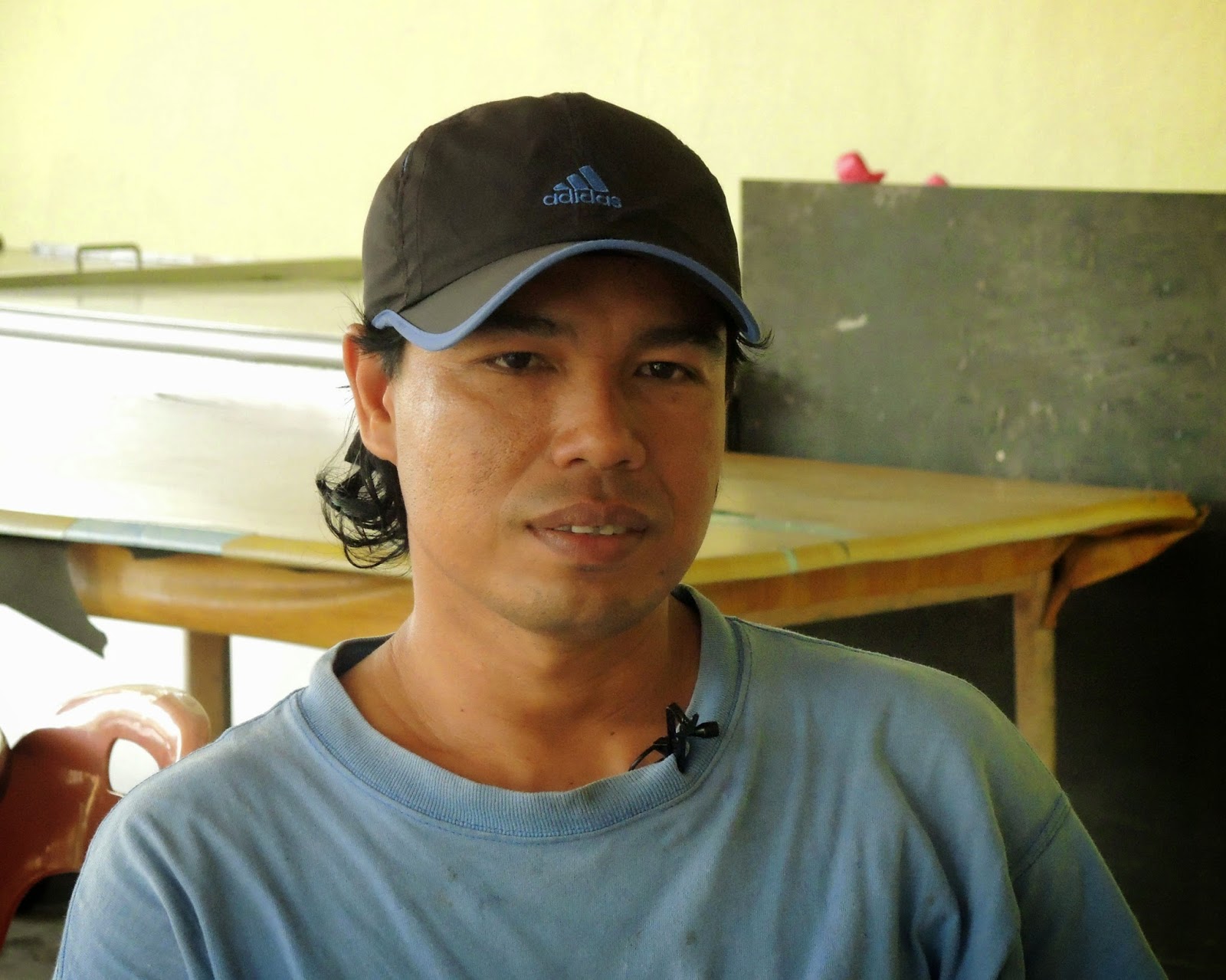
Abdul Ghani bin Abdul Rashid, Fisherman 
Ghani says.

“The fishermen are stunned. They don’t know what’s happening,” adds Bakhtiar. Bakhtiar thinks that proving fishermen with trawlers to go out father into the sea into the straits of Malacca would be a good idea.

“Train the children of the fishermen to operate the trawlers because many of them will end up as fishermen themselves anyway. Some will go on to colleges and universities but the majority will remain to inherit their father’s vocation,” he says. 


Survey? What survey?

“There are people claiming to have done a poll and the results indicate that the people here support the development of Forest City. Who did they survey? They certainly didn’t survey me,” says Bakhtiar. “Did they survey foreign workers living here? How many kampong people and fishermen did they survey?” asks Bakhtiar sarcastically.

“A dialogue held in September with the developers was a ruckus affair and clearly showed that the people here are unhappy with the development,” he adds.

In July this year the State government announced that developers conducting reclamation work would have to contribute 30 sen per square foot towards a fund for fishermen. (http://www.nst.com.my/node/10057).

How this will pan out is still a mystery for Bakhtiar and the two fishermen we interviewed.

“Who is going to manage this fund? How will it be used? These are issues that haven’t been revealed,” says Bakhtiar.

Being a former teacher Bakhtiar is concerned for the future generation. When he was teaching, he organized an environment club outside of the school’s curricula and followed that with an alumni club comprising of former students. They helped out NGO, Save Our Seahorses at many fact-finding projects concerning the environment and in particular around the Merambong Shoal.

“What’s going to happen to the youth of this village when there are no more fish, prawns and crabs to earn from?” he asks. “Nobody asks the youth here what they want, and they should be asked because it’s their future,” he says.

The Fishermen’s Association

We asked about their Fishermen’s Association. The fishermen shook their heads. “We don’t want to say anything. It would not sound very nice, says Norhaidi.

According to Bakhtiar, the information doesn’t get to the fishermen. “Whatever information the association received doesn’t get filtered down to the members.

They seem to think that because they are elected, they can decide on what to do without informing or briefing the others. “How can they do this especially on important issues, but that’s the level of their
thinking because that’s their level of education,” says a cynical Bakhtiar. The two fishermen seem to have resigned themselves to an uncertain future.

Quotes Norhaidi fatefully; “Ibarat batu tengelam. Ibarat sabut timbul” or ‘if you are lucky you will float and if you are unlucky, you will sink’.

“Many of us don’t even own the land we live on; we are either squatting on property of relatives or on government land. If we are forced to move, where will we go?

If they offer low cost housing, we won’t be able to buy because banks will never approve our loan applications; we don’t have a salary slip.

“You wait and see. Fishermen here will be living under bridges and underpasses soon,” says Norhaidi.